Projector
Projector
Monitor
Lighting
Remote Work & Learning
By Series
becreatus-dockInteractive Display & Signage
We use cookies and similar technologies on this website to improve our service for you and bring you a more personalized user experience.
By accepting optional cookies, you can enjoy:
Personalized support and live chat (Functional cookies)
Relevant content via anonymized analytics (Analytics / Performance cookies)
Ads and marketing tailored to your interests (Advertising / Targeting cookies)
By clicking “Accept all”, you consent to the use of cookies, including optional cookies. Click “Reject all” to reject optional cookies or click “Cookie Setting” to manage your preferences. Please note that rejecting optional cookies may affect certain website features and functionality. Find out more in our Cookie Policy and Privacy Policy.
Always active
These cookies are required for the operation of the website and cannot be configured.
These cookies allow us to offer you customized content according to your profile, your interests and your usage. By accepting these cookies, you help us to improve the layout and features of our site.
These cookies allow us to understand how you access the site and your browsing habits (e.g. pages viewed, time spent on a page, content clicked). They allow us to analyze the performance and design of our site and to detect possible errors. Owing to these performance indicators, we are constantly improving our site and our products, content and offers.
These cookies are used for BenQ advertisements displayed on third-party websites, including social media, and are tailored to your preferences and to help us measure the effectiveness of our advertising campaigns. They remember that you have visited our site and share this information with partners, such as advertisers, for the purpose of targeted advertising. If you refuse these cookies, advertising (including ours) will continue to be displayed as you browse the Internet, although they will not be specific to your personal interests, and will therefore be less relevant.
Important Product Recall Notice - GV31
Learn MoreImportant Product Recall Notice - GV31
Learn More
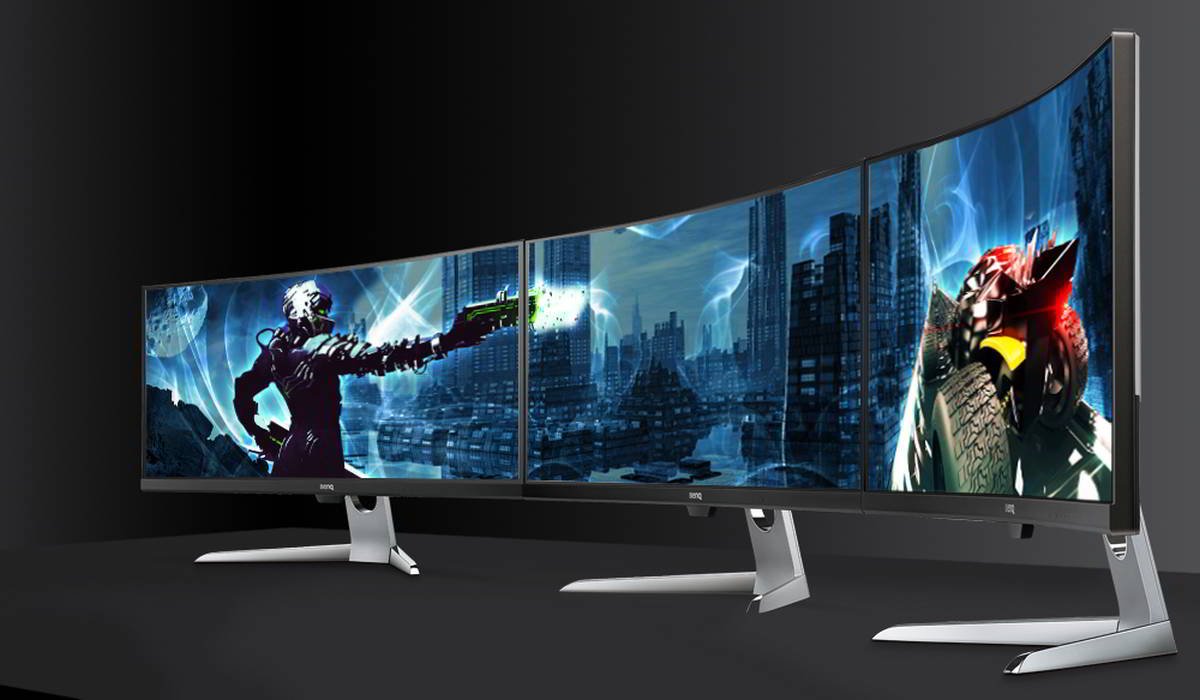
With nearly three times the resolution of full HD 1080p, ultrawide gaming monitors with 3440 x 1440 offer tons of gaming and desktop screen space without a hefty performance penalty. They look fantastic, draw you in without cropping images like regular 16:9 screens, and go easier on your graphics card.
Not necessarily. "Ultrawide" in ultrawide gaming monitors refers to the screen ratio of a monitor, these days typically a ratio of 21:9 rather than the standard 16:9 of mainstream monitors.
Don’t confuse ultra HD with ultrawide, they’re not the same. Ultra HD implies a resolution of 3840 x 2160 or more (including 7680 x 4320, or 8K). Ultrawide indicates a monitor that’s wider than 16:9 on the horizontal scale, hence 21:9. These monitors are excellent for gaming and big desktop space for multitasking, but they’re not necessarily 4K. Be sure to check our latest take on the benefits of ultrawide gaming monitors.
The majority of ultrawide gaming monitors ship in 3440 x 1440 which doesn't reallty qualify as 4K as it doesn't have the required 8.3 million pixels. However, it offers a very inviting and impressive field of view, particularly appealing to gamers. Most ultrawide monitors are curved to further increase their immersion factor.
The closest right now ultrawide monitors get to 4K is 3840 x 1600. That’s nearly 4K at over 6 million pixels – which still comes up short of 8.3 million. This resolution is quite rare and not many brands make monitors that offer such a solution. You’re better off with the popular 3440 x 1440, which is nearly the same in terms of pixel count.
Technically yes, as manufacturers can physically make panels in any size. But such a monitor would be impractical, expensive, and incompatible with most games and apps. The aforementioned resolutions, especially 3440 x 1440, have become standard and enjoy wide support. With 3440 x 1440 you’re very close to 4K and on a 32” or 35” monitor won’t be able to tell the difference. You won’t feel like you’re missing out on anything if you decide to go for an ultrawide gaming monitor as opposed to a 16:9 4K display. It’s just a matter of whether or not an ultrawide curved monitor catches your fancy.
Since 3440 x 1440 consists of around 5 million pixels and not 8.3 million, it’s a lot easier on graphics hardware than full 4K. But at the same time, it’s still over nearly three times the resolution of full HD. That’s a gaming sweet spot. Which is why ultrawide 3440 x 1440 gaming monitors routinely achieve over 100Hz native refresh rates for reasonable prices. Meanwhile, most 4K gaming monitors still stick to 60Hz unless you go for more premium models.
Opting for a 3440 x 1440 screen means you can get excellent game performance out of mid-to-high range graphics cards like the RTX 2060, as opposed to the much more expensive RTX 2080 or RTX 2080 Ti you’ll need for native 4K at similar framerates.
It’s not all perfect. Since 3840 x 2160 and 2560 x 1440 monitors vastly outnumber 3440 x 1440 displays, not every game and app supports ultrawide resolutions natively, and you may be forced to find third party mods to make things work. Major game releases should all be fine and fully compatible, but smaller, independent games could prove troublesome to get working on ultrawide. Keep that in mind when making your decision.
{{item.productWordingTag}}
{{currency}}{{item.finalPrice| numberThousandsCommas | numberDecimalPoint}} Save {{currency}}{{item.saveAmount | numberThousandsCommas | numberDecimalPoint}} Save {{item.savePercent | numberThousandsCommas | numberDecimalPoint}}%
new device price{{currency}}{{item.regularPrice| numberThousandsCommas | numberDecimalPoint}}