{{item.name}}
Price: {{currency}}{{item.price| numberThousandsCommas | numberDecimalPoint}}
Qty: {{item.amount}}


Projectors

Monitors
Lighting
Interactive Displays & Signage
Remote Work & Learning
Shop
If you’re shopping for a new portable projector, you need to keep lens adjustment and positioning in mind. Simple portables have fixed lenses and poor or non-existent keystone correction, meaning their projection angling and adjustment offer nearly no flexibility. That forces you to scramble for stuff to place projectors on to get somewhere close to a desired result. Good portable projectors banish these troubles with adjustable hinges and built-in auto keystone correction. You need these features whether you’re watching a movie, gaming, or doing homework with the kids.
Auto keystone correction is vital in properly aligning and positioning projected images relative to the surface they’re projected onto. Keystone correction allows a projector to tilt and swivel its lens while positioned on a flat surface so that the projected image looks well-placed, all without having to move the projector itself. Auto keystone correction means there’s an algorithm within the projector’s processor that controls a mechanism to self-adjust the lens, without requiring user involvement. Absent good keystone correction, you’re often forced to accept distorted, off-axis images that become annoying to behold really fast. Having proper keystone correction is one of the things that makes excellent portable projectors.
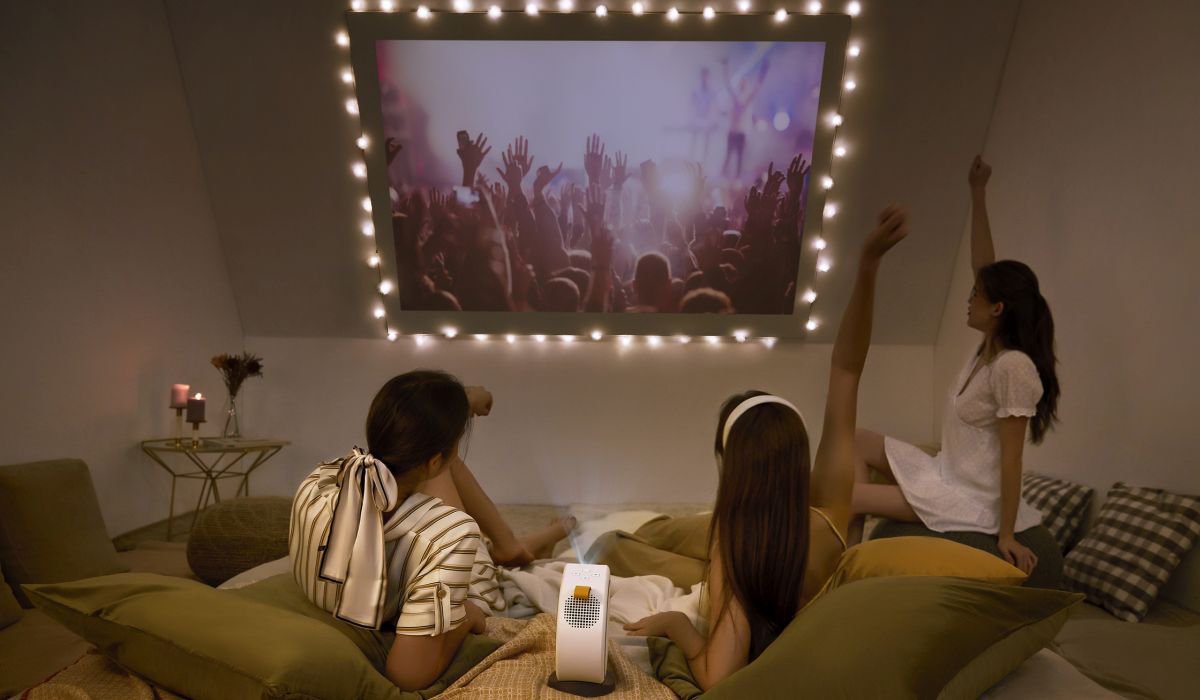
Some of the projectors like BenQ GV Series take it a step further. BenQ GV Series has a 135-degree rotation angle that makes it easy to project on ceilings without having to flip the projector and risk damage to the product. You can freely adjust lens angle for a truly laid-back experience in bed.
GV11 and GV30 are members of the same family, and they share a unique round design that gives them wide angle projection and makes viewing content on any surface easy, including your ceiling. That’s ultimate relaxation right there. Enjoy your laid-back movie time with the BenQ GV series of portable projectors.
Articulating hinge designs capable of tilt and height adjustment, whether at the base of the lens assembly or at the foundation of the portable projector, make a huge difference. Beyond keystone correction, hinges offer a much wider angle of projection to accommodate numerous locations and situations. Entirely fixed projectors limit that flexibility. They lead to awkward situations where you need stacks of magazines or unstable surfaces like pillows to get the image where you want on a screen or a wall, and even then it’s a bunch of trial and error.
And it’s not just choice of projection angle that matters, as the quality of projection is clearly important. Portable projectors worthy of acclaim use LED-based DLP (digital light processing) technology that’s way beyond what simple LCD projectors can accomplish. For one, there’s resolution. Pocket projectors may look cool, but sadly the technology doesn’t yet exist to make them more than a novelty for a quick meeting at the office. Most of them are barely standard definition. Comparably, good portable projectors offer 720p HD and above, with full HD 1080p becoming normal.
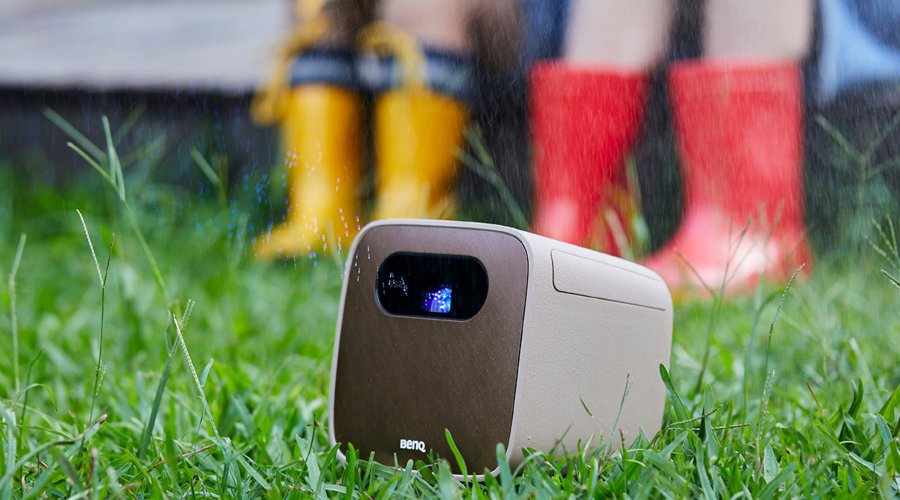
Well-designed portable projectors where engineers put in the effort to deliver controllable lenses, height adjustment, and reliable moving parts also tend to be much more durable than your average generic product. This makes a lot of sense when you think about it. The good ones weren’t just quickly made to sell en masse for a week during Black Friday, they were made to last – and stay. So you get stuff like water, moisture, drop, and shock resistance. Because portable means…going places, and the going sometimes involves all kinds of surprises. From the occasional rain fall to falling off a shelf. A good portable projector takes that into account, so you don’t need to buy a new one if such an eventuality comes to pass.
Don’t worry, this may seem like a lot to take in, but choosing the right portable projector isn’t that difficult. Equipped with the right insight, you’ll be able to spot the good ones in no time at all!
Recommended Products
{{item.productWordingTag}}
{{currency}}{{item.finalPrice| numberThousandsCommas | numberDecimalPoint}} Save {{currency}}{{item.saveAmount | numberThousandsCommas | numberDecimalPoint}} Save {{item.savePercent | numberThousandsCommas | numberDecimalPoint}}%
new device price{{currency}}{{item.regularPrice| numberThousandsCommas | numberDecimalPoint}}