{{item.name}}
Price: {{currency}}{{item.price| numberThousandsCommas | numberDecimalPoint}}
Qty: {{item.amount}}

Remote Work & Learning


Projectors

Monitors
Lighting
Interactive Displays & Signage
Remote Work & Learning
Shop
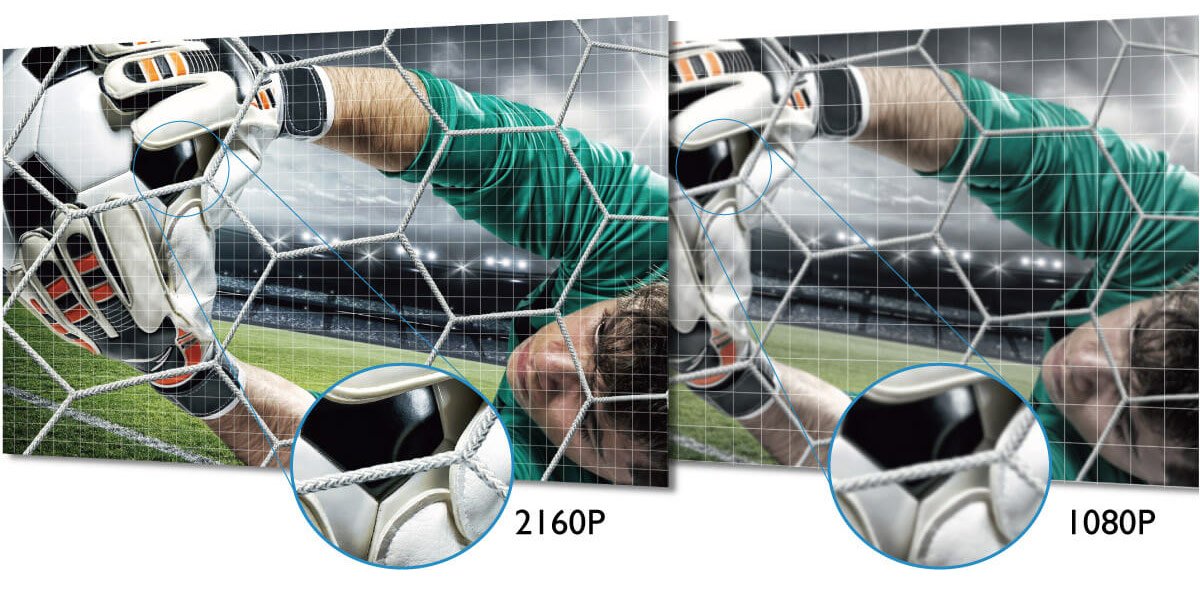
There are many components to building your own home theater system, starting with a projector. For a picture like you see at the cinema, you’ll need to get a home theater projector that’s capable of true 4K resolution, with 3840x2160 or 4096x2160 pixels. The more pixels, the more vivid the picture contents are. The technology that’s used inside your projector to produce the picture is important too. DLP (Digital Light Processing) is the leading projection display technology on the market. The DLP chip inside BenQ’s 4K projectors uses a technology called pixel-shifting, which can achieve true 4K resolution with 8.3 million distinct pixels.
We’ve put together a few questions to help you pick out the right 4K DLP projector.
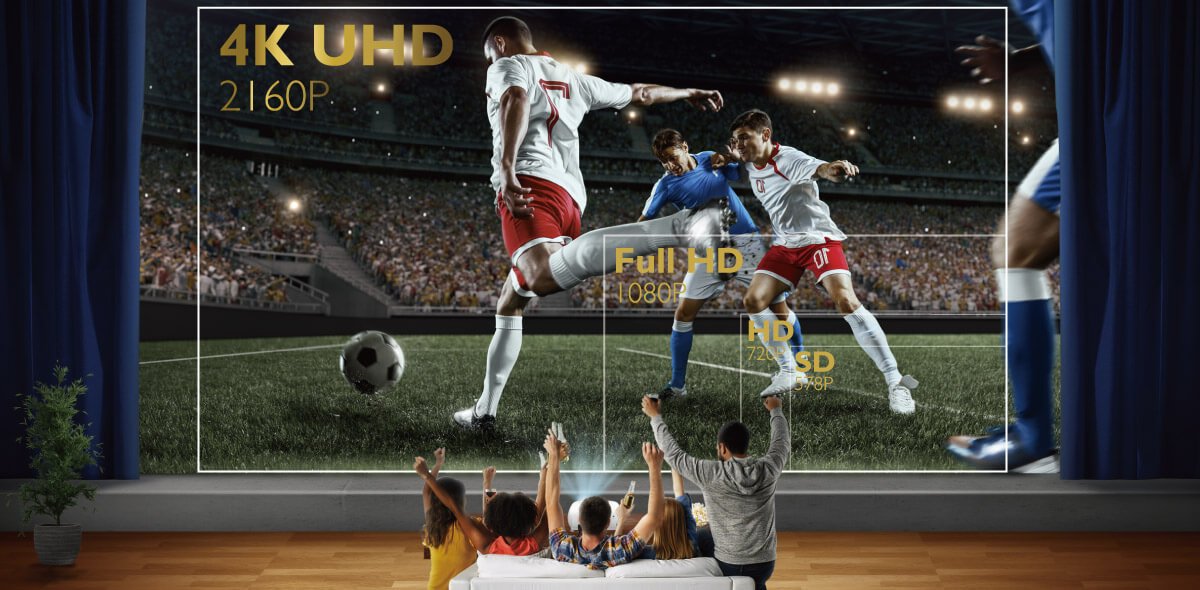
CTA (Consumers Technology Association), defines 4K UHD, or True 4K, as visuals that must deliver 8.3 million distinct pixels on the screen, which is four times the resolution of Full HD 1080p. 4K resolution produces sharp, detailed images, enhacing the home theater experience.
Resolution
Horizontal x Vertical Pixels
Total Number of Distinct Pixels
Other Names
Devices
2160p
3840x2160, 4096x2160
8.3+ Million
4K, UHD, Ultra HD, Ultra-High Definition
Projectors, TVs
WUXGA
1920x1200
2.3 Million
Widescreen Ultra Extended Graphics Array
Projectors, monitors
1080p
1920x1080
2.1 Million
Full HD, FHD
Projectors, TVs, monitors
720p
1280x720
0.92 Million
HD, High Definition
Projectors, TVs
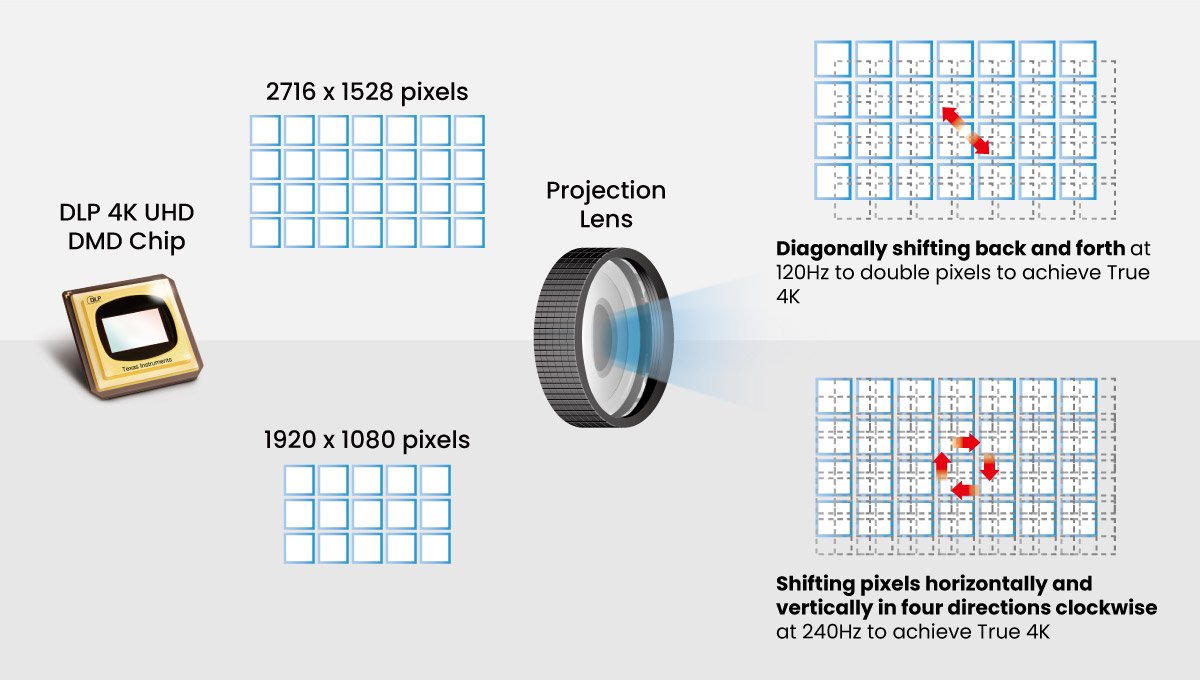
Our True 4K DLP technology, developed by Texas Instruments, empowers projectors to achieve authentic 4K resolution with 8.3 million distinct pixels, regardless of the native pixel count on the DMD chip. It achieves this by either doubling the DMD's 2716x1528 pixels or quadrupling the DMD chip's 1920x1080 pixels, resulting in a genuine 4K quality with lightning-fast pixel shifting speed.
Both True 4K DLP Technology for DLP projectors and 4K-Enhancement Technology for other projector systems utilize pixel-shifting techniques, but they yield fundamentally different results.
True 4K DLP Technology
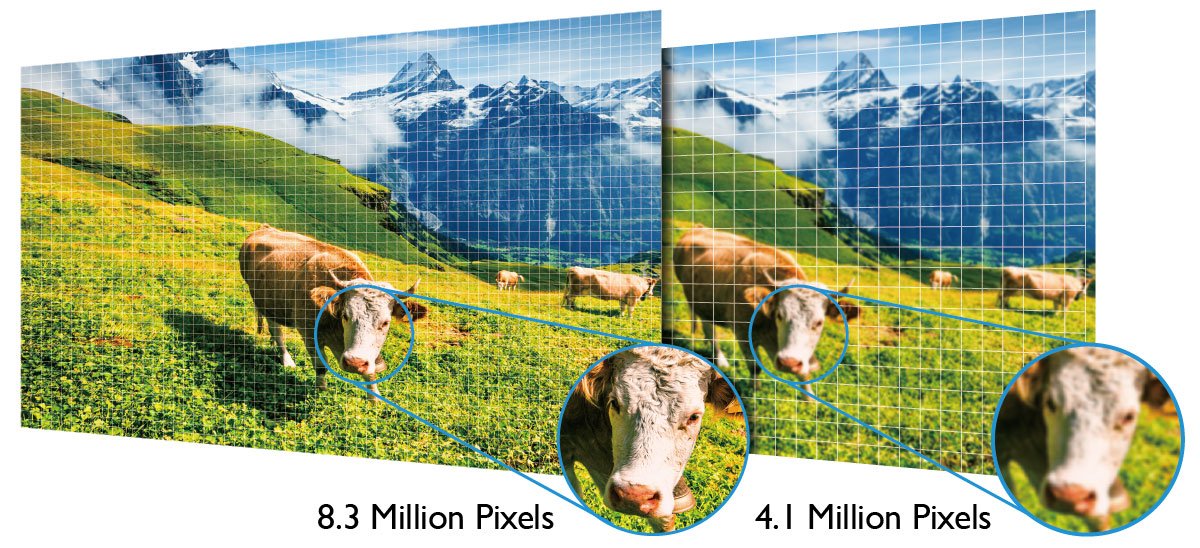
True 4K DLP Technology generates 8.3 million distinct pixels, achieved by doubling the DMD's 2716x1528 pixels or quadrupling the DMD chip's 1920x1080 pixels. This results in a genuine 4K resolution of 8.3 million pixels, all at a rapid pixel shifting rate.
4K-Enhancement Technology
4K-Enhancement Technology can only produce 4.1 million pixels by doubling the native 1920x1080 pixel resolution, falling short of the 8.3 million pixels required for true 4K resolution. This is due to the nature of liquid crystals, which can’t withstand the switching speed required to produce 8.3 million pixels.
Note
How True 4K DLP Technology Makes the Visuals Smoother
True 4K DLP technology features an actuator that increases resolution via pixel displacement on the DMD and then superimposes the pixels four times before outputting them as a single image composed of 8.3 million unique pixels. In order to make the visuals smoother, the high-speed pixel displacement utilized by the actuator entails a degree of vibration that does cause it to produce some high frequency noise.
In order to enjoy 4K HDR you’ll need the following items:
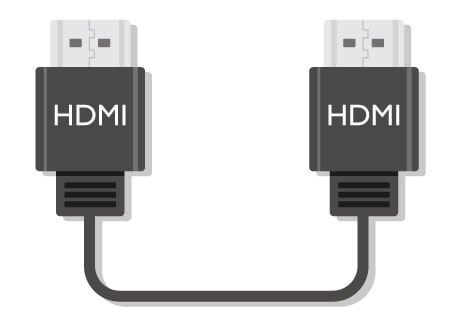
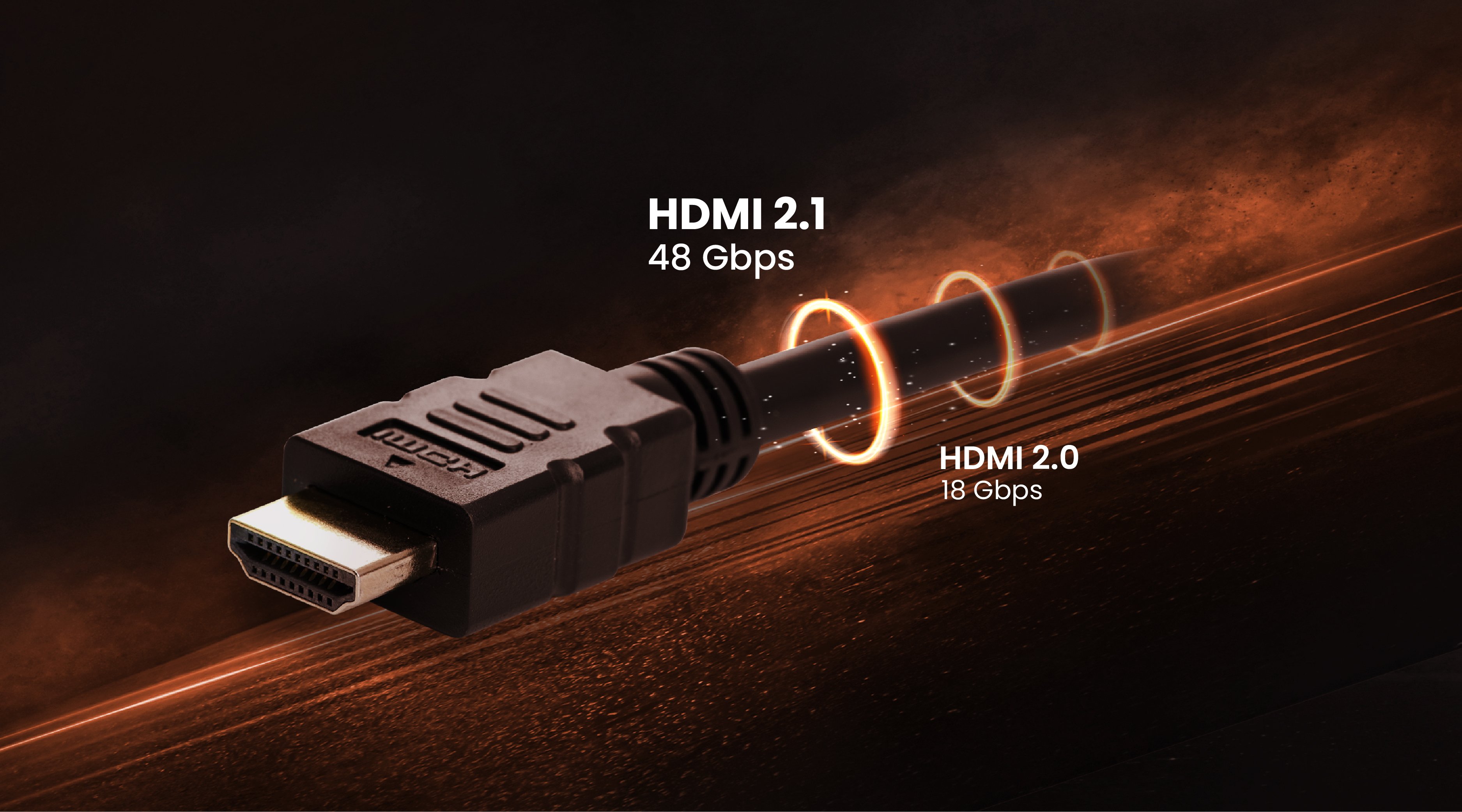
Not all HDMI cables can support 4K UHD resolution or HDR content. What is the difference between HDMI cable versions, and which one do you need?
Certification Standard
Version
Characteristics
Remark
Standard
Pre-1.4
Cannot support 4K or HDR
-
High-Speed
1.4
Certified for 4K at 24/30Hz fps only
-
High-Speed
2.0
Certified for 4K at 60Hz fps
-
High-Speed
2.0a/b
Certified for 4K at 60Hz fps with HDR
Great Choice
Premium High-Speed
N/A
Stricter testing for 4K HDR at 60Hz fps and expanded color
Best Choice
HDCP 2.2 is a copy protection file format, and all standard Blu-ray discs are protected by HDCP 2.2. For those who want to enjoy a smooth Blu-ray disc viewing experience without any hindrance, all associated disc players, amplifiers, projectors, and HDMI cables should be checked for compatibility with HDCP 2.2 decryption, to ensure the Blu-ray discs can play properly.
Since 4K Netflix files are also protected by HDCP 2.2, meaning that for all the Netflix packages you’ve subscribed to, the audiovisual system, the projector, and the HDMI cables used must be compatible with HDCP 2.2. Also, an internet connection speed of at least 25 megabits per second is strongly recommended for an optimal 4K streaming experience. For 4K 60fps video contents, a 4K 60Hz-compatible HDMI cable is also required. (Please refer to the question “Which HDMI Cables Are Needed for 4K HDR?”). For more information regarding Netflix, please refer to their website.
Recommended Products
{{item.productWordingTag}}
{{currency}}{{item.finalPrice| numberThousandsCommas | numberDecimalPoint}} Save {{currency}}{{item.saveAmount | numberThousandsCommas | numberDecimalPoint}} Save {{item.savePercent | numberThousandsCommas | numberDecimalPoint}}%
new device price{{currency}}{{item.regularPrice| numberThousandsCommas | numberDecimalPoint}}