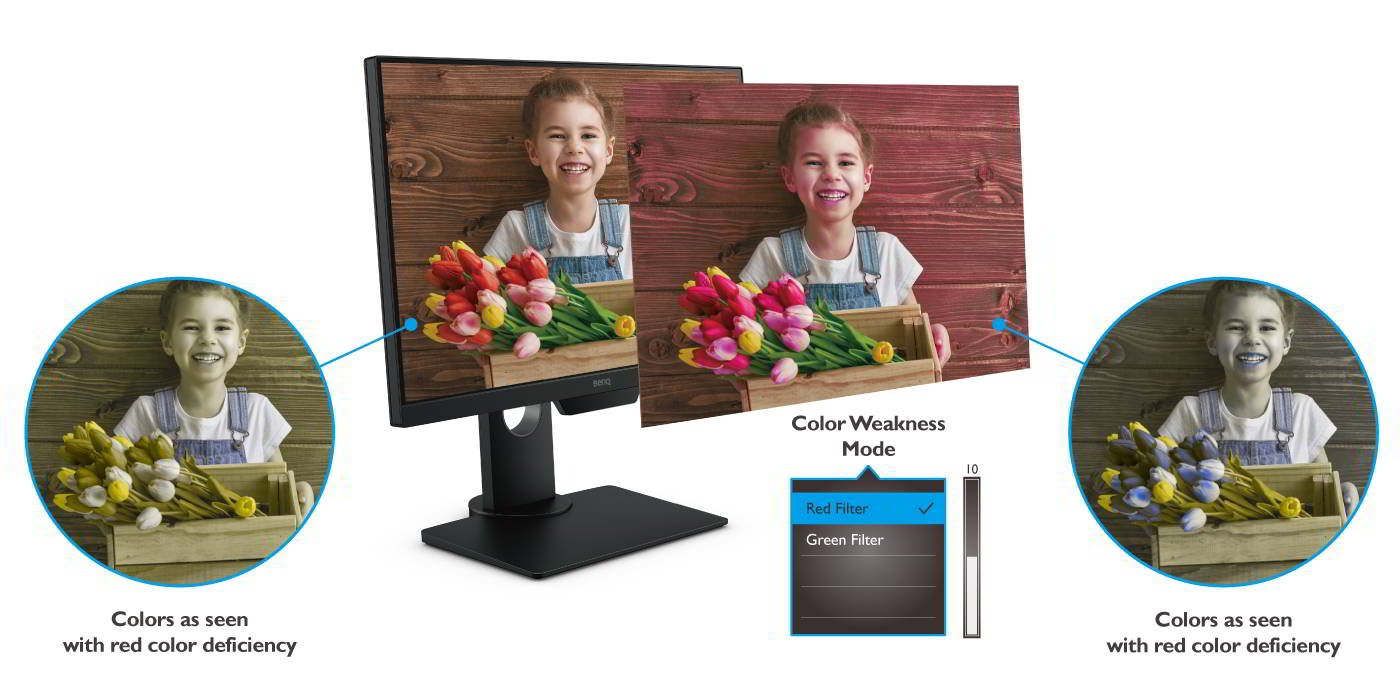
There is no cure for colour blindness, but there are ways to mitigate the issues. One such way is a BenQ eye care monitor with Colour Weakness Mode. Colour Weakness Mode assists with all of the issues connected with colour deficiency. This includes issues such as trouble distinguishing between colours or even brightness and shades of colours. Sometimes mild colour deficiencies allow colours to be seen normally in good light but difficult to see in dim light. Some can’t distinguish certain colours in any light. BenQ decided to help.
The Colour Weakness Mode technology uses red and green filters to help users who suffer from the most common type of colour blindness, which is the red-green deficiency. There are two types of this affliction: Protanomaly and Deuteranomaly. Protanomaly is a red-green colour blindness where the red cones in the retina don’t detect enough red, causing them to be too sensitive to greens, yellows, and oranges. As a result, the eye is too sensitive to reds, oranges, yellows, greens, and even browns. They all look the roughly the same, especially in low lighting. Basically, take the “Roy G.” out of “ROY G BIV” on the colour spectrum when dealing with protanomaly. The most common form is deuteranomaly, which is a reduced sensitivity to green light only.
Currently eight BenQ eye-care monitors, including EW2780U and EW3280U, feature the Colour Weakness Mode, which is easily engaged from the On Screen Display (OSD). This allows users with colour deficiencies like protanomaly and deuteranomaly, to engage Colour Weakness Mode and filter on screen images for a more natural colour viewing experience for either red or green. Users are able to adjust the Colour Weakness Mode to suit their needs.