Projectors
Accessories
Accessories
Projectors
Monitors
Lighting
Accessories
Interactive Displays & Signage
Shop
Welcome to BenQ Europe
How can I change my BenQ cookie settings?
Some essential features on BenQ sites just won’t work without cookies. And having other cookies switched off can seriously affect the way you’ll be able to enjoy our services.
Please check your cookie settings below and turn on any cookies you’re happy with.
“Strictly necessary” cookies can’t be turned off. But Functional and Performance cookies can be turned on or off below. You can learn more about cookies and what they do on our other pages.
If you've chosen to block third-party cookies on your browser, your cookie preferences won't carry over from benq.eu to benq.xx and vice versa. Please make sure to set your cookie preferences in both places.
On
Strictly necessary cookies
These cookies are essential so that you can move around the website and use its features. Without these cookies services you have asked for cannot be provided.
On
Off
Functional cookies
These cookies allow the website to remember choices you make to give you better functionality and personal features.
On
Off
Performance cookies
These cookies help to improve the performance of BenQ. If you want to opt-out of advertising cookies, you have to turn-off performance cookies.
Just landed! MA320UG 4K 120Hz Monitor for Mac
Shop NowJust landed! MA320UG 4K 120Hz Monitor for Mac
Shop Now
Important Product Recall Notice - GV31
Read moreImportant Product Recall Notice - GV31
Read more
Need advice? Our online chat connects you with real experts instead of bots
Chat with us todayNeed advice? Our online chat connects you with real experts instead of bots
Chat with us today
When you think of cinematic visuals, color is often the first thing that comes to mind. But aside from color, the application of light and its effect on the image is equally important to the visual narrative. The contrast between light and dark can be used to enhance the realism of the overall image as well as intensify the feelings of awe and wonder. In addition to focusing the audience’s attention, the interplay between light and dark can take a two-dimensional image and give it a three-dimensional feel, giving the scene increased depth and infusing rendered surfaces with greater texture, all working together to strengthen the emotional power of cinema.
For projectors with HDR, the question is how to boost dynamic contrast to make the blacks become deeper and more detailed and the whites fuller and more authentic? One of the answers is to use a dynamic iris.
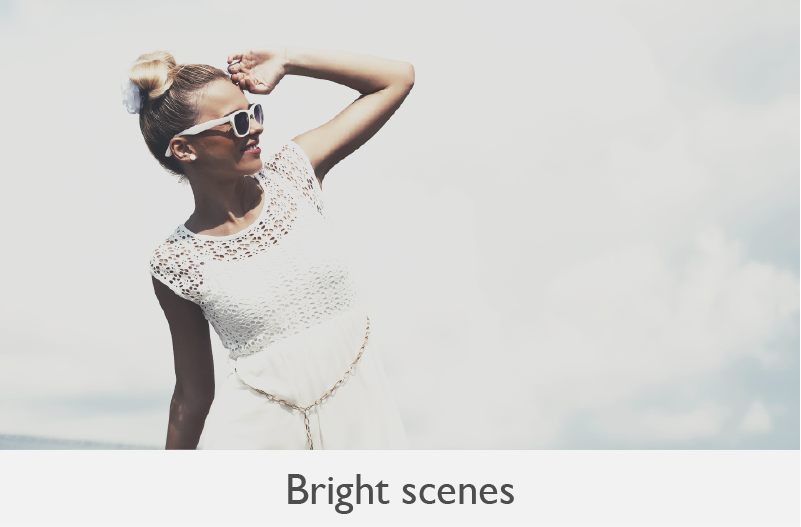
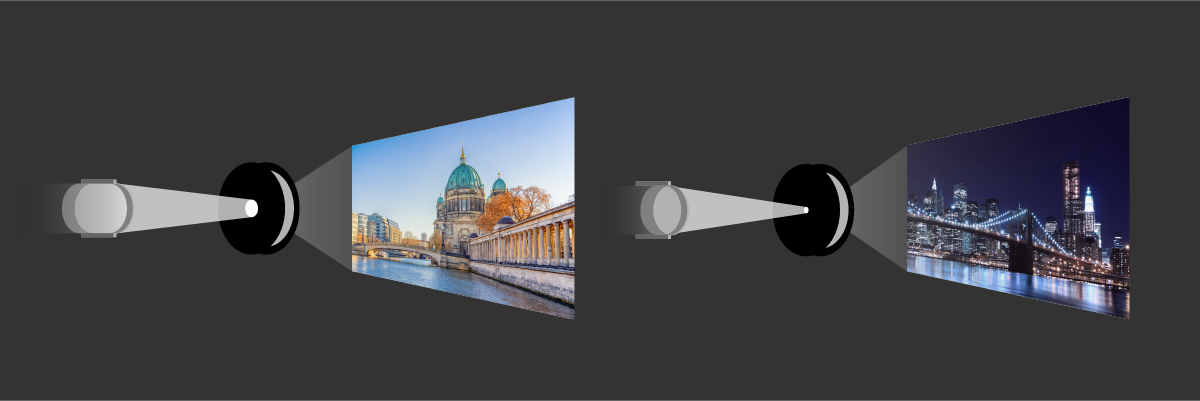
Dynamic iris is a mechanism in projectors integrated between the projector lamp and lens that opens or closes depending on the overall brightness of the projected image to adjust the projected light. For bright images the iris opens wider to allow more light, while for dark images the iris closes to reduce the amount of light projected.
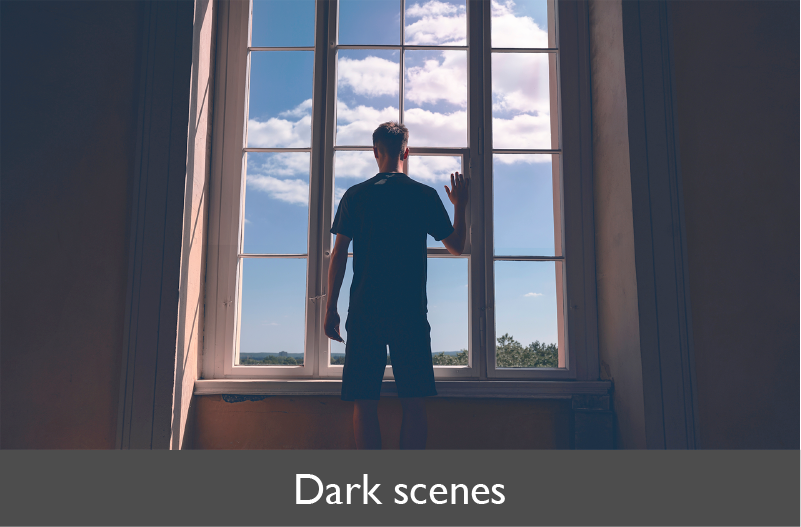
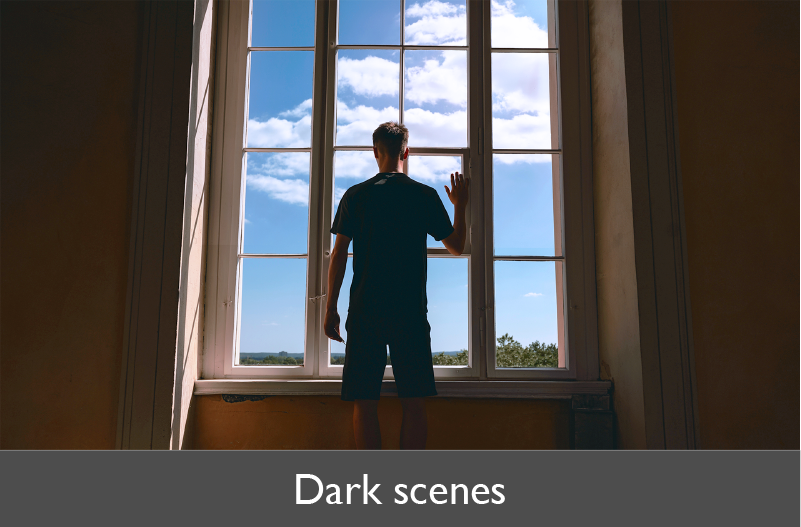
A dynamic iris is used to fine-tune the projected image by enabling the projector to enhance its on/off contrast: in other words, the difference between the brightest white when the iris is fully open and the darkest black when the iris is closed. This ensures that dark scenes are appropriately dark, while bright scenes are as bright as they can be.
Without Dynamic Iris
With Dynamic Iris
Without Dynamic Iris
With Dynamic Iris
The engineering behind dynamic irises varies across a wide range of designs to achieve the contrast-boosting effect, from different brands and even among models from the same brand. For example, some projectors use an apparatus similar to a leaf shutter on a camera, with blades moving to increase or decrease the size of the iris based on the needs of the image. Other projectors employ a wheel-like instrument with a gradually shrinking aperture, which rotates to change the size of the opening to achieve the contrast-boosting effect.
Regardless of the type of design, the fundamental principle is the same: dynamic irises increase or decrease the amount of projected light through the lens from the overall produced light from the lamp.
Dynamic irises vary across a wide range of designs
To further refine dynamic iris technology, BenQ developed the Dual Dynamic Iris solution, employing two separate irises that work in tandem to further fine-tune the amount of projected light for maximum on/off contrast. Dual Dynamic Iris projectors add a step-aperture iris to the original dynamic iris, close to the lens, which resizes itself depending on the brightness of the image to give additional control over projected light and ensure that only the ideal amount of light is projected for a given image.
Complementing these mechanics is Texas Instruments’ DynamicBlackTM, which allows the projector to evaluate the source image’s brightness level with greater sensitivity and determine more precisely how and when to deploy the projector’s irises in order to optimize light output and contrast.
Dual Dynamic Iris Solution (left: Light Mode/ right: Dark Mode)
{{item.productWordingTag}}
{{currency}}{{item.finalPrice| numberThousandsCommas | numberDecimalPoint}} Save {{currency}}{{item.saveAmount | numberThousandsCommas | numberDecimalPoint}} Save {{item.savePercent | numberThousandsCommas | numberDecimalPoint}}%
new device price{{currency}}{{item.regularPrice| numberThousandsCommas | numberDecimalPoint}}